
Winter Golf Prep: Clean Store Your Clubs and Stay Fit Off Season
The last round of the year should not end with muddy grooves, damp headcovers, and a set of clubs forgotten in the garage. Winter is hard on golf gear, and a few quiet months can also make the first spring swing feel stiff, rushed, and rusty.
A simple off-season routine solves both problems. Clean the clubs properly, store them where they will stay dry, then keep the body moving with a short golf-focused fitness plan. None of this needs to be complicated. It just needs to be consistent.

Clean every club before it goes away.
Dirt, grass, sand, and moisture can sit in grooves for months if clubs go straight from the course into storage. That buildup can dull performance and invite rust, especially on wedges and forged irons.
Start with a basic cleaning setup:
A bucket of warm water
A few drops of mild dish soap
A soft-bristle brush or old toothbrush
A microfibre towel
A dry towel for the grips
A tee or groove tool for stubborn debris
Dip the clubhead into the warm soapy water, but avoid soaking the ferrule or shaft for long. Scrub the face, sole, and grooves. Pay extra attention to wedges, since those grooves collect the most sand and turf.
For woods and hybrids, use less water. Wipe the crown and face with a damp cloth, then clean the grooves gently. Avoid harsh brushes on painted surfaces.
Once clean, dry each club fully. This matters. A club that looks clean but stays damp in the bag can still develop rust spots over the winter.
Do not forget the grips. Wipe them with a damp towel and a small amount of mild soap, then rinse with a clean damp towel and dry them well. Grips collect sunscreen, sweat, dirt, and oils. Clean grips feel better in spring and may last longer.
Check for small problems before spring.
Cleaning is the best time to inspect the set. You do not need to be a club builder to spot obvious issues.
Look for:
Loose clubheads
Cracks in graphite shafts
Dents or deep scratches
Rust on wedge faces
Smooth, shiny, or cracked grips
Bent or damaged ferrules
Ripped seams in the golf bag
A little rust on some raw wedges may be normal, but deeper rust or pitting deserves attention. If a grip feels slick now, it will not feel better after months in storage. Regripping during the off-season can save time when tee sheets fill up in spring.
This is also a good moment to empty the bag completely. Take out old scorecards, snack wrappers, wet gloves, half-used towels, and loose tees. Store rangefinders, batteries, and electronics indoors, away from freezing temperatures.
Store clubs where moisture cannot win
Cold is not the main problem. Moisture is. A damp shed, unheated garage, or car trunk can expose clubs to condensation, temperature swings, and mildew.
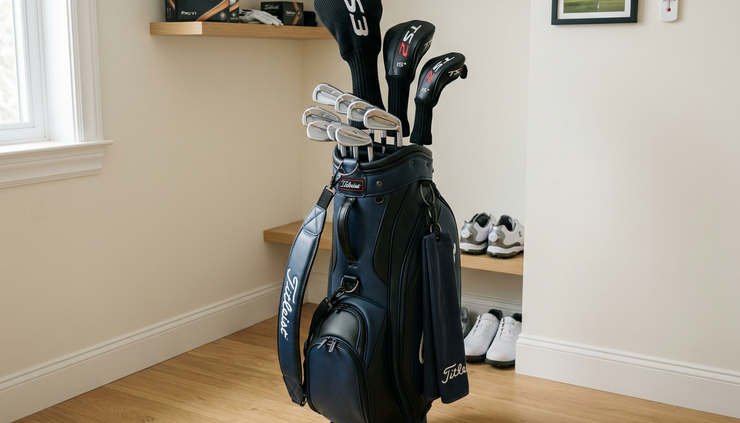
The best storage spot is dry, stable, and indoors, such as a basement storage area, spare room, or closet. If the clubs must stay in a garage, keep them off the concrete floor and away from leaky doors or windows.
Better choice | Risky choice |
Dry indoor closet | Car trunk all winter |
Bag standing upright | Clubs lying under heavy items |
Headcovers removed until dry | Damp headcovers zipped on |
Electronics stored indoors | Rangefinder left in a freezing bag |
Before putting the clubs away, make sure the bag is dry. Open all pockets. Let towels and gloves dry separately. If headcovers are wet, remove them and let them dry fully before putting them back on.
For longer storage, keep clubs standing upright in the bag. Avoid stacking heavy objects on top of shafts, especially graphite shafts. A little care now keeps the set ready for the first warm weekend.
Build a simple off-season golf fitness routine.
Golf fitness does not need to mean heavy gym sessions or complicated equipment. The goal is to maintain mobility, build useful strength, and keep rotation smooth.
This sample plan is informational only. If an exercise causes pain, stop. Anyone returning from injury or managing a health condition should check with a qualified health professional.
Aim for three short sessions per week, about 25 to 35 minutes each. Add easy walking on other days when the weather allows.
Start with mobility.
Use this warmup before each session:
Cat-cow stretch Move slowly for 8 to 10 reps.
Open book rotations Do 8 reps per side to wake up the upper back.
Hip circles Do 8 each way per side.
Hamstring walkouts Do 6 slow reps.
Bodyweight squats Do 10 controlled reps.
This prepares the hips, spine, and shoulders, which all matter in the golf swing.
Add strength that carries over to golf.
Work through this circuit 2 or 3 times. Rest as needed and keep the movement clean.
Exercise | Reps | Why it helps |
Goblet squat or bodyweight squat | 8 to 12 | Builds leg strength and posture |
Glute bridge | 10 to 15 | Supports hip extension and stability |
Split squat | 8 per side | Trains balance and lower-body control |
Push-up or incline push-up | 6 to 12 | Builds upper-body strength |
Band row or dumbbell row | 10 per side | Supports posture and shoulder control |
Side plank | 20 to 30 seconds per side | Trains core stability |
No weights? Use bodyweight and slow the tempo. A controlled squat with good form beats a rushed weighted squat every time.
Finish with rotation and balance.
Golf needs rotation, but it also needs control. Add one or two of these at the end:
Pallof press with a resistance band Do 8 to 10 reps per side.
Half-kneeling torso rotation Do 8 slow reps per side.
Single-leg balance Hold for 30 seconds per side.
Slow practice swings Make 10 swings at half speed, focusing on balance and rhythm.
The off-season is a great time to move better, not just swing harder.
Keep the routine easy enough to repeat.
The best winter plan is the one that actually happens. Put club care on one weekend afternoon, then set a weekly fitness schedule that fits normal life.
A simple week could look like this:
Monday Strength and mobility
Wednesday Mobility, rotation, and balance
Friday or Saturday Strength circuit and easy practice swings
Any day Walk, stretch, or do light movement
If there is room indoors, make a few slow swings with a short club or training aid. Keep the focus on tempo, setup, and balance. Avoid full-speed swings in tight spaces, especially near walls, ceilings, pets, or people.
Clean clubs and a prepared body make spring golf more enjoyable. When the first tee time arrives, the bag is ready, the grips feel fresh, and the swing has not been asleep all winter. That is the real win of off-season prep.


Comments